How to Split Expenses in Multiple Currencies (Without Losing Track)
Splitting a dinner four ways is easy. Splitting a two-week trip where one friend booked the flights in rupees, another paid the hotel in dollars, and every taxi and bowl of pho came out of a fistful of Vietnamese dong — that is where most bill-splitting breaks down. Not because the math is hard, but because everyone quietly converts at a different rate — and nobody likes a balance sheet that doesn’t match.
There is a cleaner way to do it, and it starts with a rule that sounds almost too simple.
Rule one: log every spend in the currency you actually paid
The instinct is to convert on the spot — you pay ₫793,500 for a boat trip, you pull up a converter, and you log ₹2,650. Don't. Every one of those conversions is a guess made at a slightly different moment, at a slightly different rate, and once they are baked into your records you can never unpick them.
Log ₫793,500. Log $940. Log ₹3,800. Keep each spend in the currency it was born in, and let the conversion happen later, in one place you control.
Here is why that matters, with the real numbers from one trip. Two of us left India carrying $2,000 in cash, bought at home for ₹190,479 — ₹95.24 to the dollar. In Vietnam we changed $740 of that into ₫19,367,500, which turned out to be every dong the trip ever spent. Chain the two together and our dong cost us ₹1 for every ₫275.
That rate never moved again. We bought the envelope once and spent it over fourteen days. The mid-market rate a converter would have used moved plenty in that fortnight — and it was never our rate anyway, because two currency counters took their spread on the way in.
So if you convert each spend at the moment you log it, your records fill up with rates you never actually paid, and a ₫60,000 bowl of pho in week one is recorded at a different cost from the identical bowl in week three. Nothing about your trip changed. Only the internet’s opinion of the rate did.
Store the dong. One rate, applied once, at the end — the rate you actually got.
Rule two: keep one group, not one group per currency
The common workaround is to spin up a separate group for each currency — a rupee group, a dollar group, a dong group. It feels tidy for about a day, and then nobody can answer the only question that matters: what do we owe each other, in total?
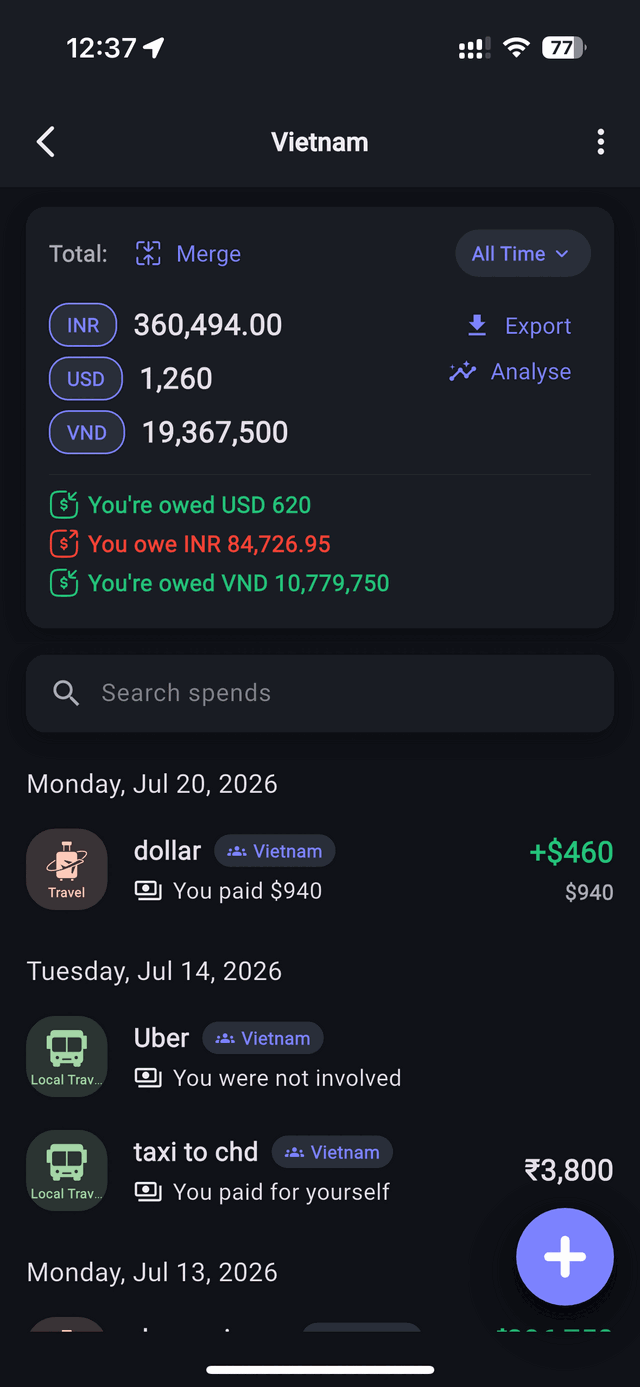
One group per trip. Every spend goes in, whatever currency it was paid in, and the group holds all of them side by side. In Split Money, a group total looks like this when you keep the currencies separate:
- ₹ 360,494
- $ 1,260
- ₫ 19,367,500
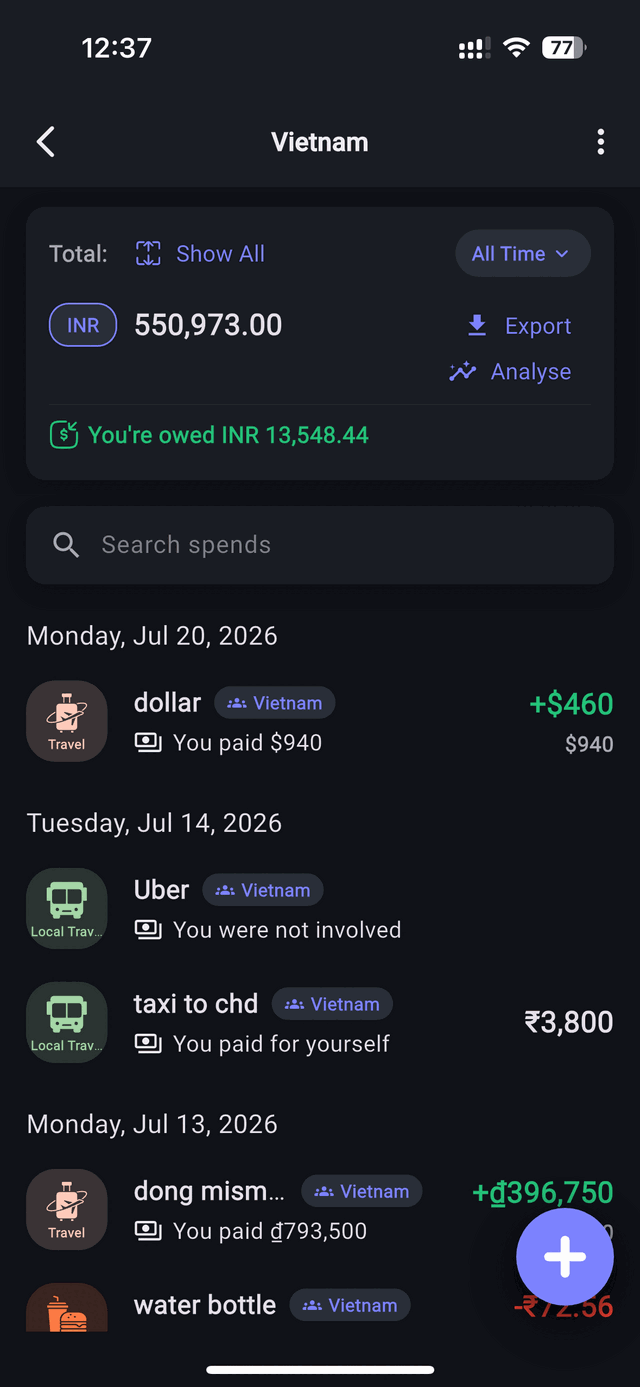
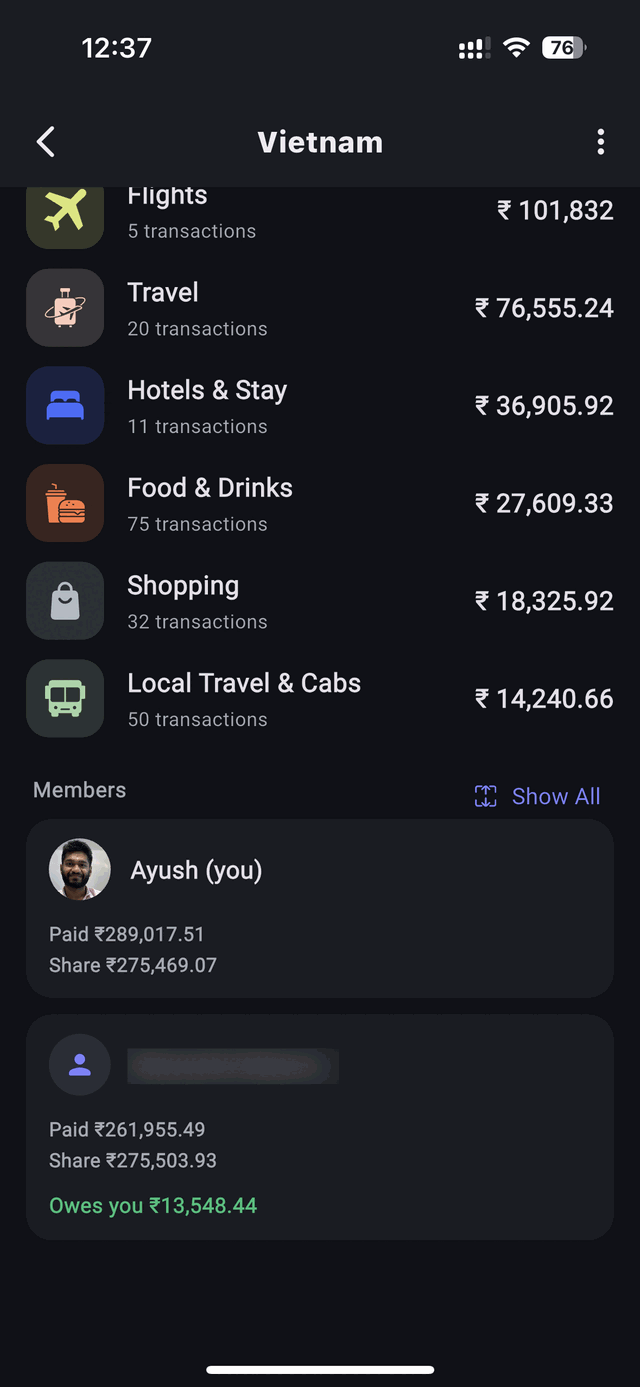
Three real numbers, none of them invented. Tap Merge and the same group collapses into a single figure — ₹ 550,973 — converted at the rate you chose. Tap Show All and you are back to the three originals. Nothing is destroyed either way; the merged view is a lens, not a rewrite.
Rule three: your balances should be per currency too
This is the part most tools get wrong, and it is the part that causes actual arguments. A single merged “you are owed ₹13,548” hides something important: which money you are owed.
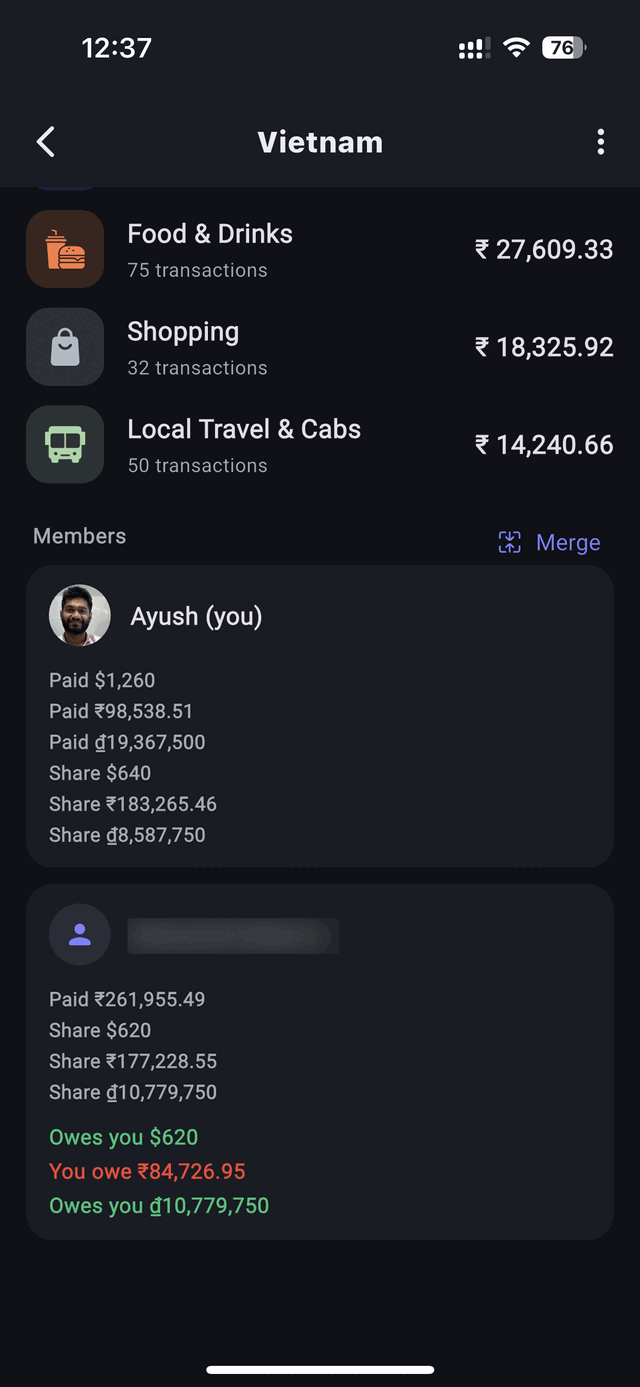
Split the same balance out by currency and the picture is completely different:
- You’re owed $620
- You owe ₹84,726.95
- You’re owed ₫10,779,750
Same relationship, same friend, same trip. But now you can settle the way people actually settle — hand over the dong in cash tonight, square the rupees by bank transfer at home, and leave the dollars alone if you are both travelling again next month. A merged number can only ever tell you the net; a per-currency breakdown tells you what to do.
Rule four: pick your rate deliberately — live, or the one you actually got
There are two honest ways to convert, and the right one depends on the trip.
Live rates are the sane default. Nobody has to look anything up, nobody has to agree on anything, and the merged total tracks the real market. For a weekend across a border, or a group where the amounts are small, this is all you need.
A rate you set yourself is better the moment real money changed hands at a real rate. You pulled the local currency out of an ATM and your bank charged you what it charged you. You changed dollars at a kiosk at a rate that was frankly a robbery. That is the rate the trip actually cost you — not the mid-market number on a finance site. Split Money lets you set a custom conversion rate on the group itself, so every merged total and every balance in that group uses the rate your group agreed on, for as long as you want it to.
It is worth seeing what that does to a real total. Take the trip above: $2,000 of cash bought for ₹190,479, $740 of it changed into ₫19,367,500, the remaining $1,260 spent as dollars, and ₹360,494 more put on a card. Set the group to those rates and the dollars come to ₹120,002, the dong to ₹70,477 — ₹190,479 together, which is exactly what that cash cost at the counter. Add the card spending and the merged total lands on ₹550,973. Not an approximation of the trip. The trip.
Rule five: split each spend as it happens, not at the end
Multi-currency or not, this is still the habit everything rests on. Whoever pays, logs it, right then, in the local currency — and marks who it was for. Some spends are for the whole group. Some are “you paid for yourself.” Some you were not involved in at all, but you still want them in the group total because they are part of what the trip cost.
All three of those are normal, and a good tool should record all three without complaint. What you should not have to do is remember, two weeks later, that the ₫793,500 boat trip was only three of the four of you.
A worked example
Two friends, two weeks in Vietnam. Flights booked from home in rupees. A shared $940 charge on a card. Then two weeks of taxis, street food and hotels in dong.
- As it happens: each spend goes into one group in its own currency. ₹3,800 taxi, $940 booking, ₫793,500 boat trip.
- During the trip: the group shows three running totals and three running balances. Nobody converts anything, nobody argues.
- Setting the rate: you both changed money at the same place, so you set that rate on the group — the real one, not the mid-market one.
- Last night: merge the totals to see the trip's true cost in one number, then look at the per-currency balances to settle. Dong in cash over dinner, rupees by transfer on the flight home.
Total time spent on money admin: about four minutes, spread across two weeks.
What to look for in an app
If you are choosing a tool for a multi-currency trip, these are the things that actually matter:
- Per-spend currency — not one currency per group with everything force-converted on entry.
- Both views — merged single-currency total and the untouched per-currency breakdown, switchable at any time.
- Per-currency balances — so “who owes what” survives contact with reality.
- Custom conversion rates — set per group, so the rate you actually paid is the rate the group uses.
- Offline entry — you will be logging a cab with no signal and a foreign SIM that has not woken up yet.
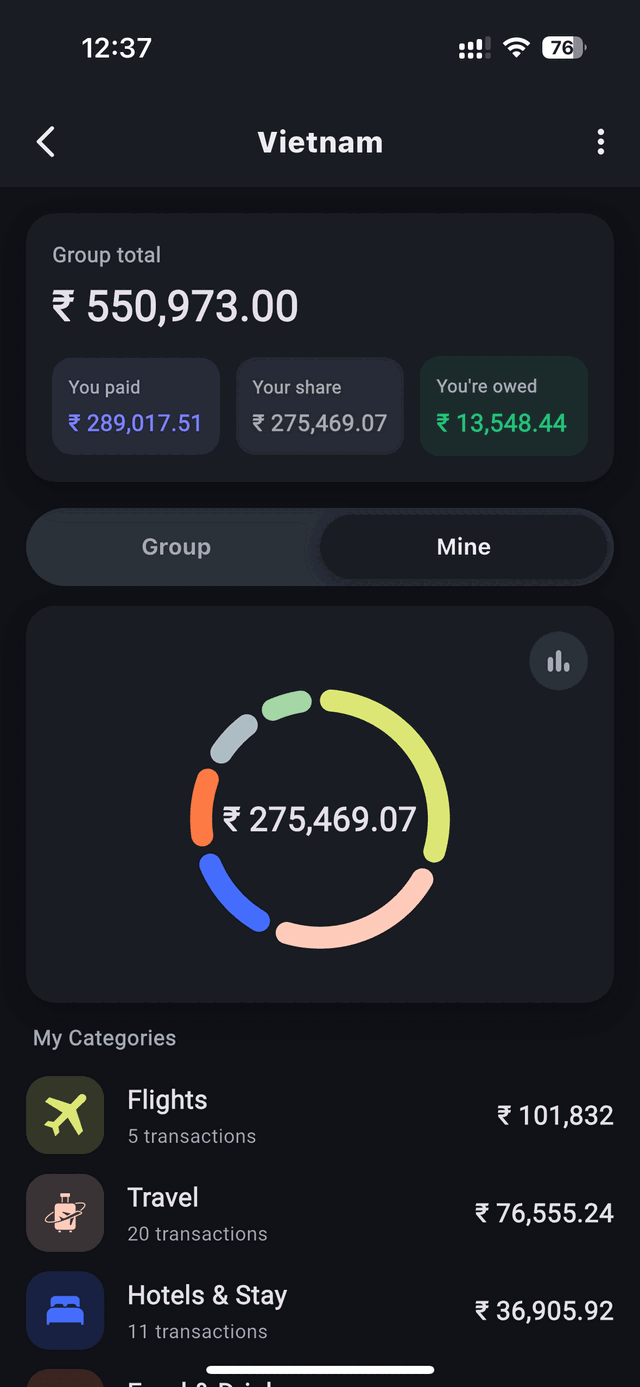
- Category and member breakdowns — what the trip cost by flights, hotels, food and cabs, and what each person paid versus their share.
Frequently asked questions
Should I convert foreign spends to my home currency when I log them?
No. Log the amount you actually paid, in the currency you paid it in. Converting on entry bakes a one-off rate into your records permanently. Convert at the viewing stage instead, where you can change the rate later or switch it off entirely.
How does a multi-currency group total work?
Two ways, and you want both. Unmerged, the group shows a separate running total per currency — three currencies, three real numbers. Merged, it converts them all into one currency for a single trip cost. Merging is just a view; the original amounts are never overwritten.
Live exchange rates or a fixed rate I set myself?
Live rates are the right default for casual, small-amount splitting. Set your own rate when actual money changed hands at a known rate — an ATM withdrawal, a cash exchange, a card statement — because that is what the trip genuinely cost you. In Split Money the custom rate is set on the group, so everyone in it sees the same converted numbers.
Can I owe someone in one currency and be owed in another?
Yes, and that is normal on a long trip. Keeping balances per currency lets you settle each one the natural way — cash for local currency now, a bank transfer for home currency later — instead of forcing one awkward combined payment at a rate somebody has to accept.
What if one person withdrew all the local cash for the group?
Log the spends in local currency as normal, then set the group's conversion rate to the rate that withdrawal actually got. The cost of obtaining the currency then gets shared across the group rather than silently absorbed by whoever visited the ATM.
Does this work for things other than travel?
Yes — freelancers billing across borders, flatmates on different payrolls, families splitting a cost between two countries. Anywhere more than one currency touches the same shared pot, the same five rules apply.
Split across currencies without the mental math
Log every spend in the currency you paid, merge into one total when you want it, and settle in whichever money makes sense.