The Best Way to Split Expenses on a Group Trip (A System That Actually Works)

Group trips run on shared spending — cabs, meals, that one hostel someone booked for everyone. And they run into trouble the same way every time: nobody wants to be "that person" doing the math, so nobody does it, and by day four no one actually knows who owes what.
The good news is that avoiding it doesn't take a finance degree or a color-coded spreadsheet. It takes five small habits, agreed on before you leave. Here's the whole system.
Set the ground rules before you go
Two minutes in the group chat before the trip saves hours of awkwardness during it. Agree on three things up front:
- Where tracking lives — one shared place, decided now, not five different apps mid-trip.
- The default split — almost always "even," with exceptions handled case by case.
- When you settle — ideally on the last evening, before everyone heads to different airports.
- What happens when the money changes — if you're crossing a border, agree that everyone logs spends in the currency they actually paid, and nobody converts anything by hand.
1. Log it the moment you pay, not at the end of the day
Trip memory is unreliable. "I think I covered the tuk-tuks twice" is not a number you can settle up on. Whoever pays, logs it — right there, right then, before the next thing happens and it's gone. This is the habit everything else depends on.
2. Split by default, adjust by exception
Most trip costs should split evenly, automatically — shared cabs, group meals, the Airbnb. Only step in to customize when something's genuinely uneven: someone skipped the expensive dinner, someone took the private room, two people did the scuba add-on and the rest didn't. Default to even, override when it actually matters, and don't agonize over rounding a few coins.
3. Log in the currency you actually paid — convert later, once
The moment a trip crosses a border, this becomes the habit that decides whether your numbers survive. The instinct is to convert on the spot: you hand over ₫793,500 for a boat trip, you pull up a converter, and you write down ₹2,650. Don’t. Write down ₫793,500.
Two reasons. The small one is that everyone in the group will look up a slightly different rate at a slightly different moment, so your totals quietly stop matching each other. The big one is that a live rate is almost never your rate.
Here is what that means in practice, from a real trip. Two of us left India carrying $2,000 in cash, bought at home for ₹190,479 — ₹95.24 to the dollar. In Vietnam we changed $740 of that into ₫19,367,500, which turned out to be every dong the trip ever spent. Chain those together and our dong cost us ₹1 for every ₫275. We bought the envelope once, at that rate, then spent it over fourteen days. The rate never moved again. Only the internet’s opinion of it did.
An app that converts at the moment you type reaches for that opinion instead, so a ₫60,000 bowl of pho in week one gets recorded at a different cost from the identical bowl in week three. Store the original amount, and convert once at the end — ideally at the rate you actually got.
4. Keep one shared group, not five side conversations
If tracking is scattered across three group chats and someone's Notes app, nobody has the full picture and every settle-up starts with an archaeology dig. One shared group, visible to everyone on the trip, settles the "wait, what did we decide?" problem before it starts — and it means the quiet person who never speaks up about money can still see exactly where they stand.
5. Settle up before the trip ends, not after everyone's scattered
Chasing a friend for a small amount three weeks after a trip, over text, is worse for the friendship than the money itself. It turns a shared good memory into a nagging errand. Settle on the last night while everyone's together, in a good mood, and phones are out anyway. Once people scatter to different cities and time zones, that same conversation gets ten times harder.
A worked example, with real numbers
Two of us, two weeks in Vietnam. The flights went on an Indian card in rupees, weeks before we left. One booking was charged in dollars. Everything on the ground — taxis, street food, hotels, boat tickets — came out of dong.
Logged as we went, each spend in the currency it was actually paid, the group ended the trip reading like this:
- ₹360,494 on the card
- $1,260 in cash dollars — what was left of the $2,000 envelope after $740 of it became dong
- ₫19,367,500 in dong
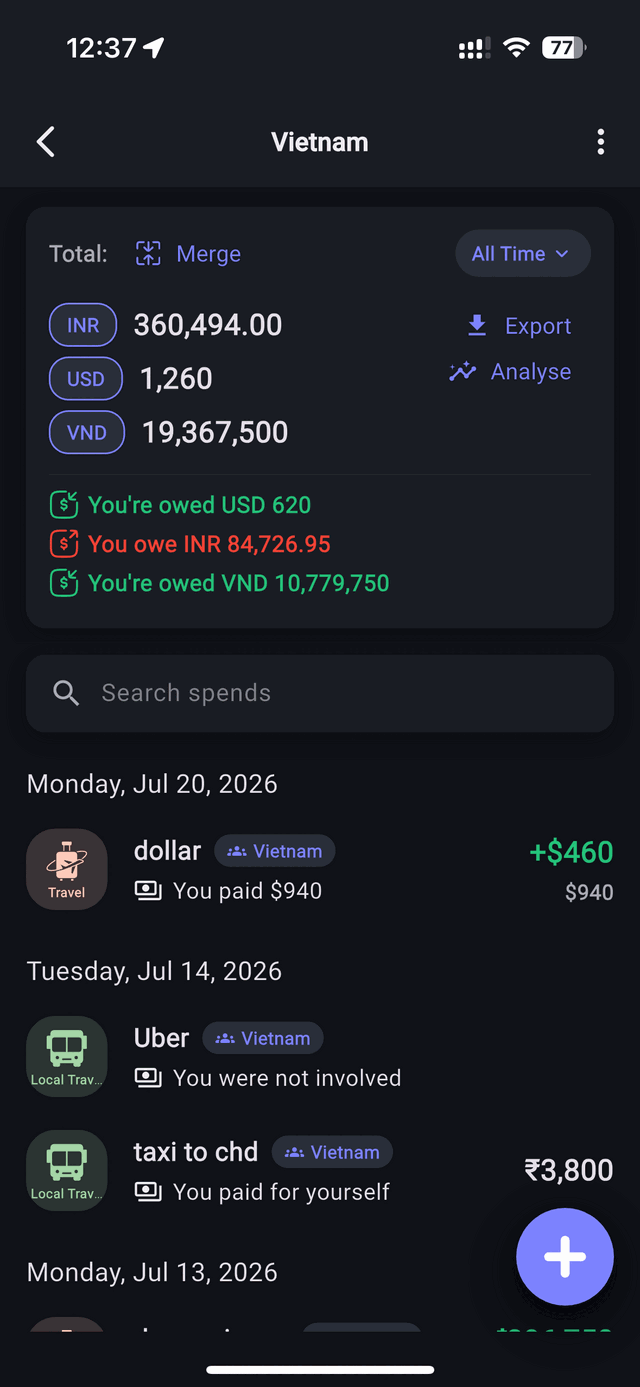
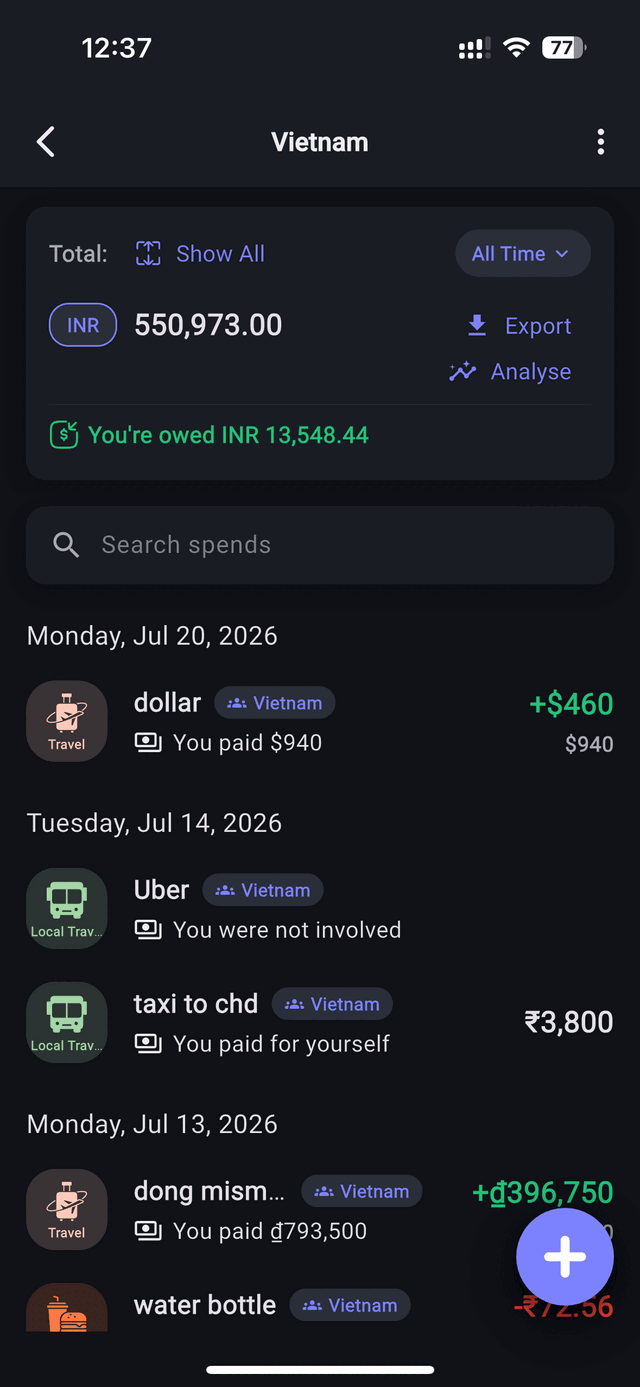
On the last night we set the group to the rates we had actually paid — ₹95.24 to the dollar, ₫275 to the rupee — and merged. The $1,260 came to ₹120,002 and the ₫19,367,500 came to ₹70,477: ₹190,479 together, which is to the rupee what that cash cost us at the counter in India. Add the ₹360,494 on the card and the trip cost ₹550,973. Not an estimate of it — it.
Settling was the easy part, because the balances stayed split by currency instead of collapsing into one number. Dong changed hands in cash over dinner; the rupee side went by bank transfer on the way home.
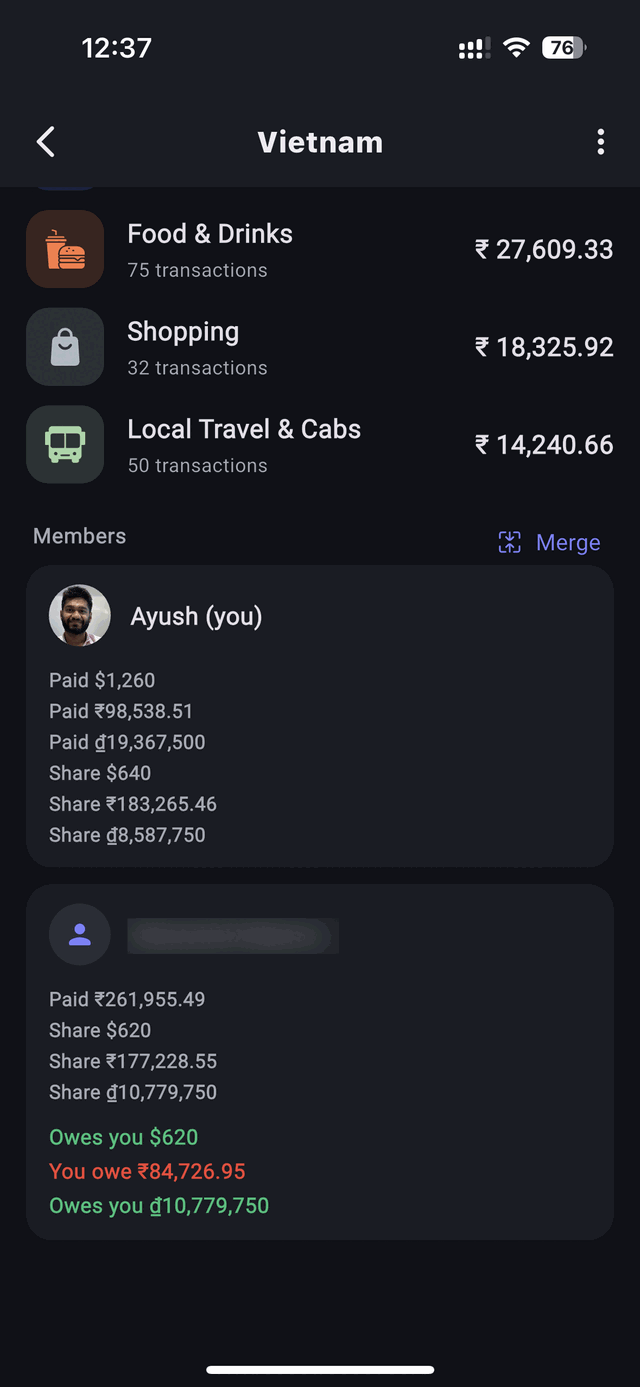
Total time spent on money admin across two weeks: a few minutes. No receipts spread across a hostel bed at midnight, and no argument about whose converter was right.
Once the trip is over, working out who owes who is its own small skill — net the positions, clear them in as few payments as possible, and never reimburse receipt by receipt.
This is close to word-for-word how Split Money’s group-trip features got built — out of exactly this problem, on exactly this trip. There is a longer version of the currency half in how to split expenses in multiple currencies, and the whole origin story in why I built Split Money.
Frequently asked questions
What's the fairest way to split group trip costs?
Default to an even split for anything genuinely shared, and use custom splits only for costs a subset of the group actually used (a tour, a private room). Fairness comes from logging consistently, not from over-engineering every line item.
How do we handle different currencies abroad?
Log every spend in the currency you actually paid and convert nothing by hand. A group should be able to hold several currencies at once, showing a separate running total for each, and merge them into one figure only when you ask it to. Converting at the moment you type permanently bakes an arbitrary rate into each record, which is how two people’s totals end up disagreeing.
Which exchange rate should the group use?
Live rates are a fine default for small amounts. But if you exchanged cash at a known rate, set that rate on the group instead — it is what the trip genuinely cost you, and it spreads the cost of obtaining the currency across everyone rather than leaving it with whoever went to the counter.
Can I owe one person in one currency and be owed in another?
Yes, and on a long trip that is normal. Keeping balances per currency lets you settle each one the natural way — local cash tonight, a bank transfer for home currency later — instead of forcing one awkward combined payment at a rate someone has to accept.
What if someone paid for almost everything up front?
That's fine — as long as every payment is logged, the "who owes what" math nets it all out at the end. The person who fronted costs simply shows up as owed, and everyone squares up on settle night.
Do we need internet to track on the trip?
Not with an offline-first app. Add spends with no signal and they sync once you're back online — which is exactly what you want when you're abroad.
Take the money stress out of your next trip
Log spends as you go in whatever currency you paid, split evenly by default, and settle up before everyone scatters.